OpenAPI Generics for Spring Boot
Keep your Java contract intact from Spring Boot to generated clients.
OpenAPI Generics is a focused Java/Spring specialization that prevents generic API contracts from being flattened into newly generated wrapper models.
Your Java contract remains the source of truth. OpenAPI carries the metadata required to reconstruct that contract deterministically on the client side.
Java Contract → OpenAPI Projection → Contract Metadata → Contract-Aligned Client
Generated clients bind to the envelope, container, and DTO types you already own instead of redefining them.
Get Started · See How It Works
Explore
- The Problem
- What’s New in 1.2.1
- Key Features
- How It Works
- Get Started
- Documentation
- Samples
- Compatibility
- Community
The Problem
A Spring Boot API may expose a strongly typed generic contract:
ResponseEntity<ServiceResponse<Page<CustomerDto>>> getCustomers()
That contract carries more than a JSON shape.
ServiceResponse<T> defines the response envelope, Page<T> defines the pagination contract, and CustomerDto defines the payload.
A conventional OpenAPI client generation flow can flatten that contract into a newly generated wrapper model:
class ServiceResponsePageCustomerDto {
    PageCustomerDto data;
    Meta meta;
}
The generated type may represent a similar JSON structure, but the original Java contract identity is no longer preserved.
OpenAPI Generics keeps that identity intact:
public class ServiceResponsePageCustomerDto
    extends ServiceResponse<Page<CustomerDto>> {}
The generated wrapper becomes a thin type binding: it reuses the shared envelope and container contracts instead of redefining them.
| Default OpenAPI Generator contract materialized as generated models | OpenAPI Generics contract reconstructed from shared Java types |
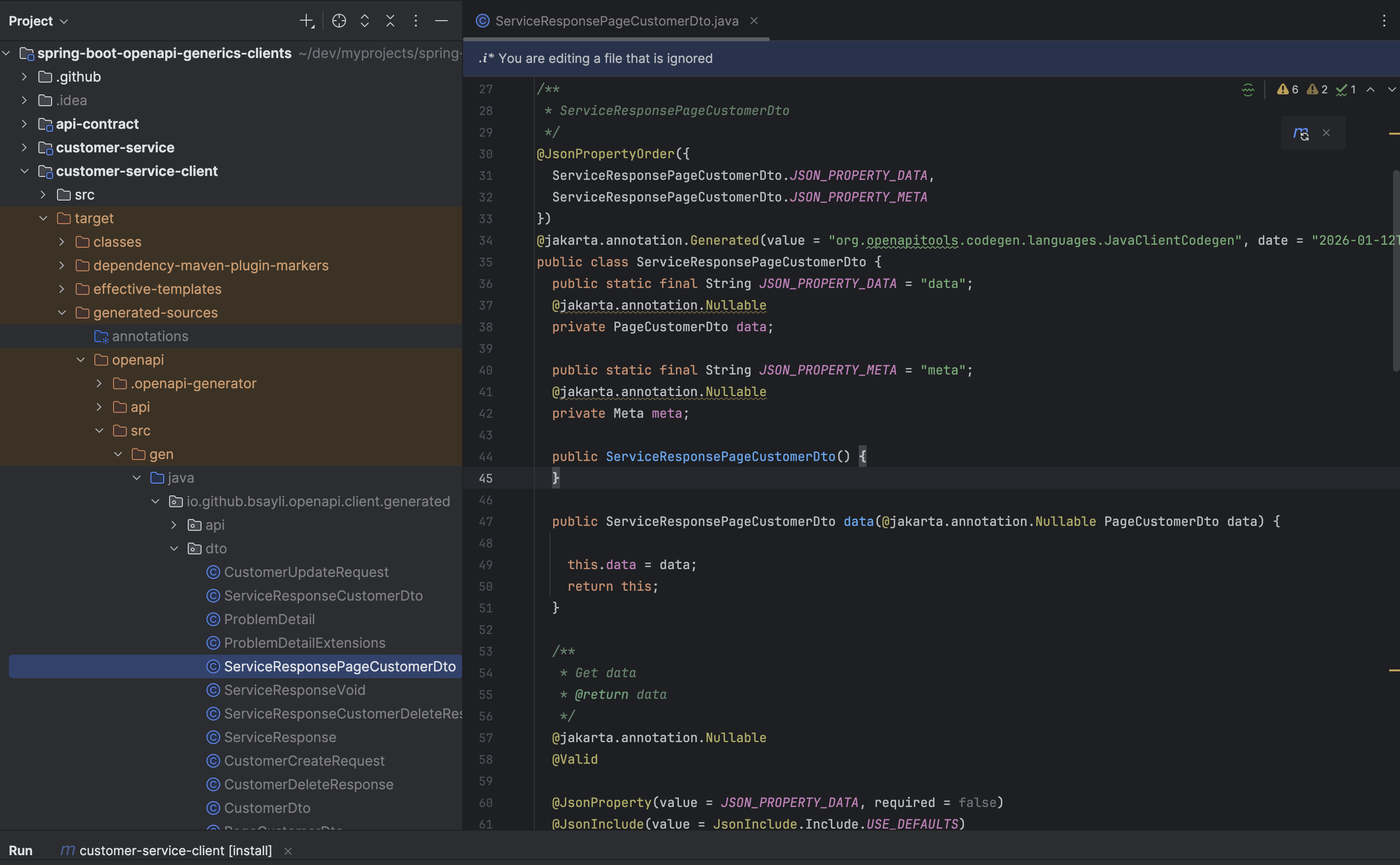 | 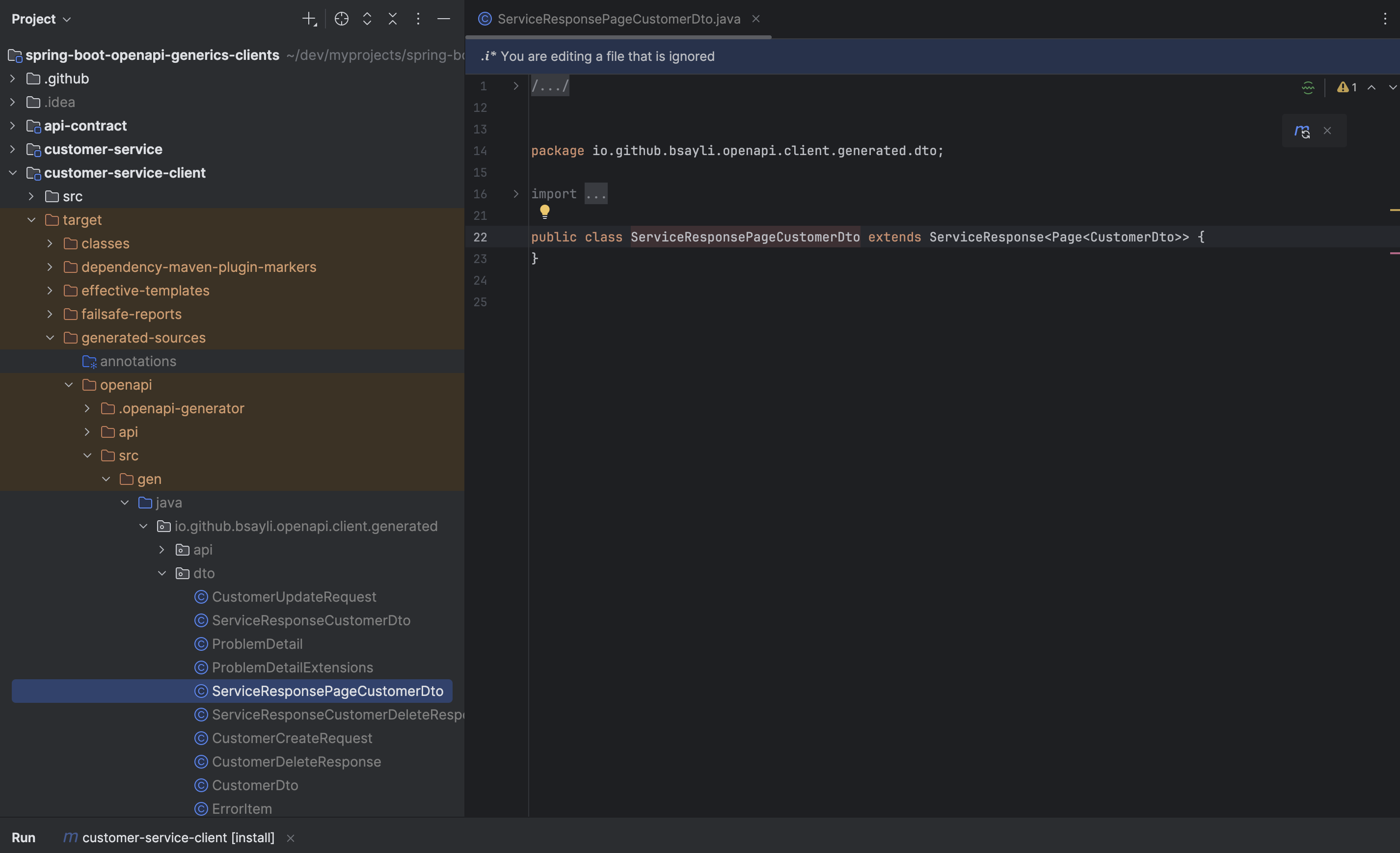 |
Why It Matters
For a single endpoint, duplicated wrapper types may look harmless.
Across many generated clients, they accumulate into additional generated models, mapping layers, and opportunities for contract drift.
OpenAPI Generics keeps the ownership boundary explicit:
Shared Java contracts remain the authority. Generated clients provide transport bindings around them instead of becoming alternative contract definitions.
What’s New in 1.2.1
OpenAPI Generics 1.2.1 completes the contract-driven reconstruction model by carrying Java envelope identity in the generated OpenAPI document through x-api-wrapper-type.
Together with x-data-container-type, the document now carries the envelope and container identity required by the Java generator to reconstruct both platform-owned and application-owned generic response contracts.
Java Contract
      ↓
OpenAPI Projection
      ↓
Envelope + Container Identity
      ↓
Generated Client Reconstruction
For aligned producer and codegen components, this removes the need to repeat the envelope declaration on the client through openapi-generics.envelope.
Representative contract shapes include:
ServiceResponse<Page<CustomerDto>>
ApiResponse<Window<CustomerDto>>
1.2.1 highlights
- Contract-driven envelope reconstruction through
x-api-wrapper-type - No duplicate client-side envelope configuration for aligned components
- Application-defined generic containers with both built-in and BYOE envelopes
- Dedicated compatibility coverage for standard multipart, binary download, and form-urlencoded transport flows
- Full backward compatibility with 1.2.0 runtime contracts
No contract migration is required for existing 1.2 users.
For the complete release history, see the Changelog.
Key Features
| Feature | Description |
|---|---|
| Java contract authority | Java contracts remain the source of truth. |
| BYOE | Reuse your own response envelope instead of migrating to a platform wrapper. |
| BYOC | Reuse externally owned DTOs instead of generating duplicates. |
| Application-defined containers | Register custom generic containers such as Paging<T> or Window<T>. |
| Contract-driven reconstruction | Reconstruct envelope identity directly from projected OpenAPI metadata. |
| Container-aware reconstruction | Built-in and configured containers share one deterministic pipeline. |
| Deterministic reconstruction | Stable projection, validation, and contract-aligned client reconstruction. |
| Generated-source hygiene | Deterministic cleanup of duplicate and unused generated imports. |
| Fail-fast validation | Invalid contract metadata and projection states fail during generation. |
| Standard transport compatibility | Generic reconstruction coexists with standard Java RestClient transport generation. |
How It Works
Spring Boot Application
      ↓
openapi-generics-server-starter
      ↓
OpenAPI + Contract Metadata
      ↓
openapi-generics-java-codegen-parent
      ↓
java-generics-contract
      ↓
Contract-Aligned Java Client
The server-side projection phase discovers generic response contracts and publishes the metadata needed to preserve them across OpenAPI.
Key metadata includes:
x-api-wrapperx-api-wrapper-typex-api-wrapper-datatypex-data-containerx-data-container-typex-data-itemx-ignore-model
The Java code generator consumes that metadata and reconstructs contract-aligned wrapper types.
The generated OpenAPI document remains valid OpenAPI and can still be consumed by standard tooling.
OpenAPI Generics does not fork OpenAPI Generator.
It adds a Java/Spring specialization layer on top of the upstream generator while leaving standard transport generation behavior intact.
Get Started
OpenAPI Generics integrates at two points in the contract lifecycle:
Java Producer Contract
        ↓
OpenAPI Projection
        ↓
Contract-Aware Client Reconstruction
Producer
Add openapi-generics-server-starter to the Spring Boot service that owns the Java contract.
The starter participates when Springdoc generates the OpenAPI document. It discovers supported generic response contracts and projects the metadata required for deterministic client reconstruction without changing application request handling.
For the built-in ServiceResponse<T> contract, no envelope configuration is required. BYOE envelopes and application-defined generic containers can be declared as part of the producer contract model.
See Server-Side Adoption for dependency setup, BYOE configuration, custom containers, validation, and projection behavior.
Client
Use openapi-generics-java-codegen-parent with the official OpenAPI Generator Maven plugin and select:
<generatorName>java-generics-contract</generatorName>
Normal OpenAPI Generator choices remain consumer-controlled, including the input specification, client library, package layout, and generator options.
OpenAPI Generics prepares the reconstruction-specific environment and restores the projected Java contract semantics without replacing the ordinary OpenAPI Generator lifecycle.
See Client-Side Adoption for the complete Maven configuration, BYOC mappings, fallback behavior, and generated-source setup.
Documentation
-
Architectural Rationale
Why OpenAPI Generics exists, what problem it solves, and the architectural trade-offs behind the project. -
Architecture
Internal projection protocol, contract metadata model, reconstruction pipeline, and validation boundaries. -
Server-Side Adoption
Publish generics-aware OpenAPI documents from Spring Boot services without changing runtime behavior. -
Client-Side Adoption
Generate Java clients that reconstruct generic contracts instead of redefining them. -
Compatibility & Support Policy
Supported and verified Java, Spring Boot, Springdoc, OpenAPI Generator, and build-time boundaries. -
GitHub Repository
Source code, releases, issues, and discussions.
Samples
Repository samples validate the complete contract lifecycle:
Producer
    ↓
OpenAPI
    ↓
Generated Client
    ↓
Consumer Runtime
The maintained sample suite covers Spring Boot 3 and Spring Boot 4 reference stacks, built-in ServiceResponse<T> contracts, BYOE envelopes, application-defined generic containers, type coverage, and standard transport interoperability.
Explore the sample projects for runnable end-to-end examples.
Compatibility
OpenAPI Generics currently supports:
- Java: 17+
- Spring Boot: 3.4.x, 3.5.x, and 4.x
- springdoc-openapi: 2.x with Spring Boot 3.x, and 3.x with Spring Boot 4.x
- OpenAPI Generator: 7.x
- Server integration: Spring WebMvc
- Client build integration: Maven
The repository maintains exact Spring Boot 3, Spring Boot 4, and OpenAPI Generator reference baselines to verify compatibility without narrowing support to those exact versions.
See the authoritative Compatibility & Support Policy for the full matrix, verified reference baselines, and support boundaries.
Community
OpenAPI Generics is open source under the MIT License.
Questions, bug reports, design discussions, and real-world adoption feedback are welcome.
